
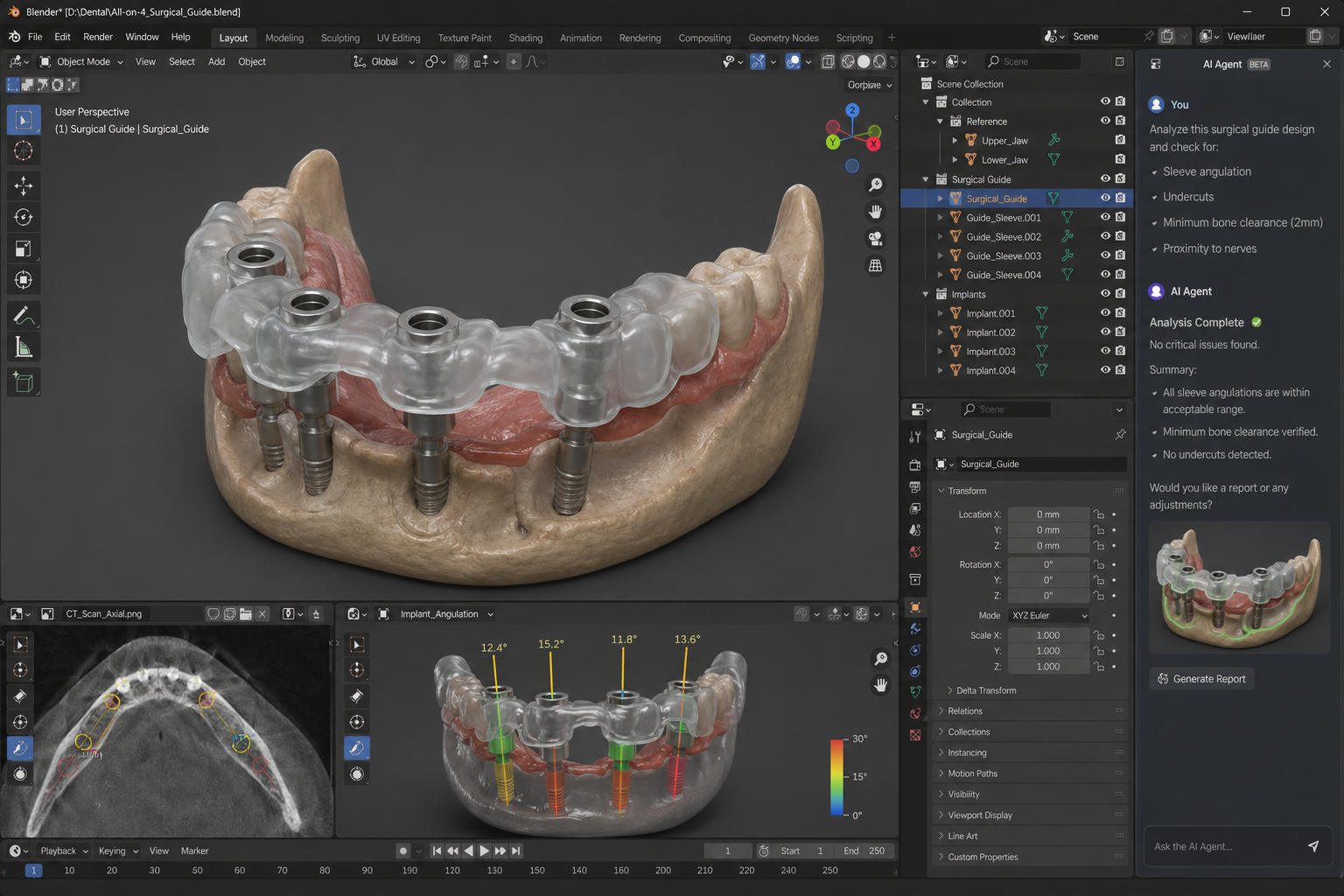
Blender is a software used for 3D design. It is one of the most complex 3D design tools in the world. It used to take months to years for a person to learn it and work with it professionally. That was until recently.
It is now possible to connect Blender to an AI agent that can use it autonomously for 3D design. This is possible because Blender is open-source. Why does this matter for the dental world?
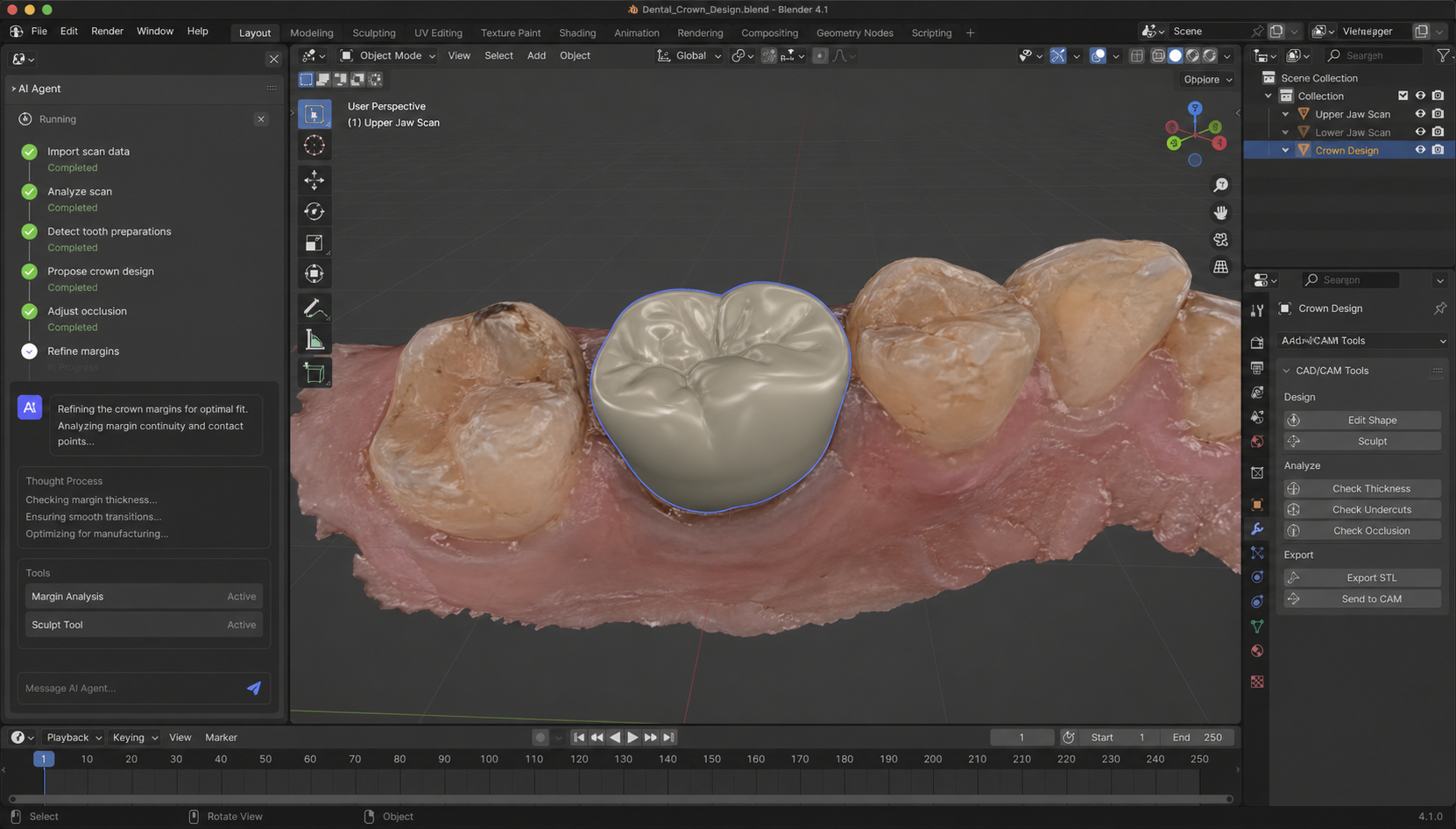
Blender is a far more complex tool than the dental 3D software used in practices and laboratories. If it can be used for complex 3D designs with the help of AI agents, there is nothing stopping dental software from developing in the same direction. In practice, this would make it possible to design dental products — crowns, bridge prostheses, surgical guides, and more — through text instructions alone.
Dental software is, of course, closed by nature — which leads to a slower pace of innovation. But that does not mean never, only later, or perhaps even "soon". Back when I was still a student, I experimented with the idea of taking a 3D scan from a CBCT and using it in Blender, then printing it on my home 3D printer. With the latest innovations, I can take that same scan and instruct an AI agent to design a surgical guide for me to print. If I also take a bite registration, I could task the AI agent with dynamically reproducing it and, on that basis, designing the future prosthetic constructions.
And the logical question follows — what comes next? Will expensive, closed dental software still make sense in the future, if free and better open platforms are developing in parallel? How will this affect dental clinics and their medium- and long-term vision for technology investment? I don't know… But if ideas and possibilities like these surface in my head, imagine what is happening inside the major medical corporations and what innovations we might see in the future…